
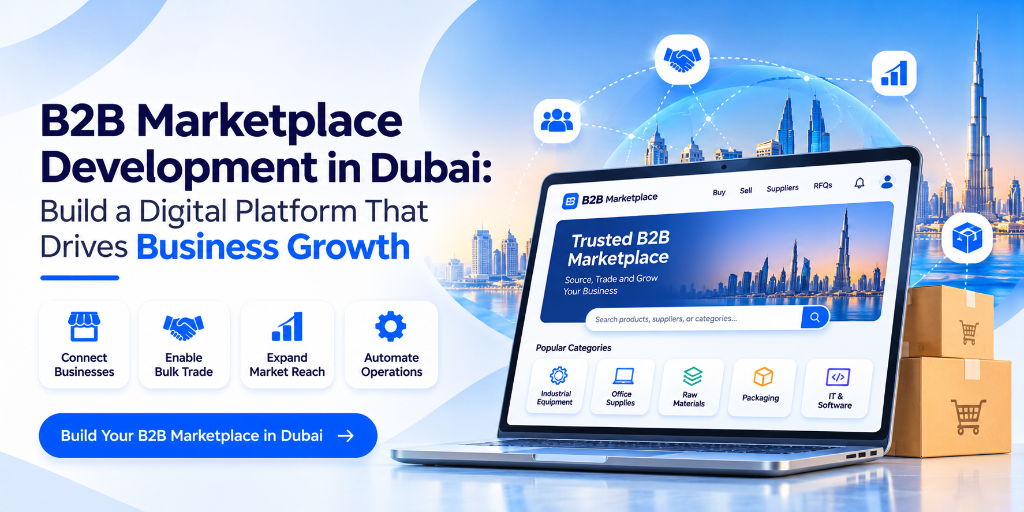
Dubai has become an important business destination for manufacturers, wholesalers, distributors, suppliers, and international traders. As businesses expand their operations, traditional methods of connecting with buyers and managing supplier relationships can become difficult to maintain.
Many companies still depend on emails, phone calls, spreadsheets, and separate communication channels to manage orders and business enquiries. These methods may work initially, but they can create delays, communication gaps, and missed sales opportunities as the business grows.
A custom B2B marketplace offers a smarter way to manage these activities. It provides a centralized digital platform where businesses can showcase products, connect with potential buyers, manage enquiries, and simplify commercial transactions.
With professional B2B marketplace development in Dubai, businesses can build digital platforms that support larger customer networks, improve operational efficiency, and create new opportunities for revenue growth.
1. What Is a B2B Marketplace and Why Does It Matter?
A B2B marketplace is an online platform that connects businesses with other businesses for buying, selling, and trading products or services.
Unlike traditional e-commerce websites that primarily target individual customers, B2B marketplaces are designed for manufacturers, wholesalers, distributors, retailers, and corporate buyers.
For example, a manufacturing company in Dubai can use a B2B marketplace to display its product catalogue, receive bulk purchase enquiries, communicate with distributors, and manage business orders through a centralized system.
This approach reduces dependency on manual communication and creates a more organized buying experience.
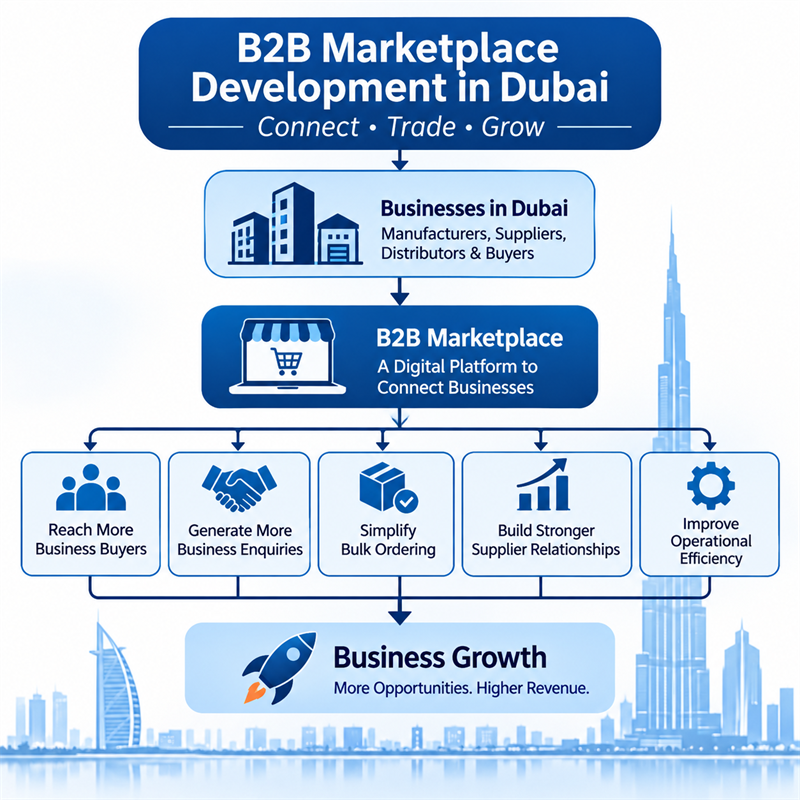
2. How Can a B2B Marketplace Help Businesses Grow?
A well-developed marketplace is not just a website. It can become an important business development channel.
Here are some ways it supports growth.
Reach More Business Buyers
A digital marketplace allows businesses to present their products and services to a wider audience.
Instead of depending entirely on existing business relationships, suppliers can attract new distributors, wholesalers, and corporate buyers through their online platform.
Generate More Business Enquiries
A marketplace can include dedicated product pages, enquiry forms, quotation requests, and direct communication features.
These functionalities make it easier for interested buyers to contact suppliers and discuss purchasing requirements.
Simplify Bulk Ordering
B2B transactions often involve customized pricing, minimum order quantities, and bulk purchase requirements.
A marketplace can support these processes through features such as:
- Bulk order requests
- Custom quotations
- Minimum order quantities
- Business-specific pricing
- Order management dashboards
This helps businesses manage purchasing activities more efficiently.
Build Stronger Supplier Relationships
A centralized platform allows buyers and suppliers to communicate, exchange information, and manage transactions more systematically.
It also helps businesses maintain better visibility into supplier interactions and order histories.
3. Essential Features Every Business Marketplace Should Include
The success of a B2B marketplace depends on how effectively its features support real business requirements.
Some important functionalities include:
1. Business Registration and Profiles
Allow manufacturers, suppliers, distributors, and buyers to create accounts with business information, contact details, and company descriptions.
2. Product Catalogue Management
Provide businesses with the ability to upload product images, specifications, descriptions, pricing information, and availability.
3. Advanced Search and Filtering
Help buyers find products and suppliers based on categories, locations, specifications, pricing, and other relevant requirements.
4. Request for Quotation (RFQ)
Allow buyers to submit quotation requests for bulk orders and customized purchasing requirements.
5. Admin Dashboard
Provide administrators with centralized control over user accounts, product listings, enquiries, transactions, and platform activities.
6. Payment Gateway Integration
Support secure online payments where required, including suitable payment methods for business transactions.
7. Analytics and Reporting
Give marketplace owners insights into product performance, buyer activity, enquiries, orders, and revenue trends.
4. Why Dubai Businesses Should Invest in Custom Marketplace Development
Dubai's business environment includes companies operating across trading, manufacturing, logistics, retail, construction, and several other industries.
A ready-made marketplace solution may not always support their specific operational requirements.
Custom development allows businesses to build platforms around their actual business models.
For example:
- Manufacturers: Connect directly with distributors and bulk buyers.
- Wholesalers: Manage product catalogues and bulk purchase enquiries.
- Distributors: Organize supplier relationships and purchasing activities.
- Retail businesses: Discover new suppliers and manage procurement.
- Logistics companies: Connect business customers with relevant transportation services.
A customized platform also makes it easier to introduce additional features as business requirements evolve.
5. How the Right Development Partner Makes a Difference
Building a successful marketplace requires more than attractive website design. It needs proper planning, scalable architecture, reliable functionality, and a user-friendly experience.
A professional development team should understand the business model before starting the development process.
The process generally involves:
- Business Requirement Analysis: Understanding the marketplace model, target users, and business objectives.
- Platform Planning: Defining essential features, user roles, workflows, and technical requirements.
- UI/UX Design: Creating an intuitive interface for buyers, sellers, and administrators.
- Development: Building frontend interfaces, backend functionality, databases, and integrations.
- Testing: Checking performance, security, usability, and transaction workflows.
- Deployment and Maintenance: Launching the platform and providing ongoing technical improvements.
Mithila Softech helps businesses explore digital development solutions that align with their operational requirements and long-term technology goals.
6. How to Make Your Marketplace Ready for Future Growth
A marketplace should be developed with future expansion in mind.
As the number of buyers, sellers, and transactions increases, the platform must be capable of handling additional requirements.
Consider these development priorities:
- Scalable architecture to support increasing platform activity.
- Mobile-responsive design for convenient access across devices.
- Strong security measures to protect business and customer information.
- Integration capabilities for accounting, inventory, and CRM systems.
- Performance optimization for faster loading and smoother navigation.
- Flexible features that support new products, categories, and business models.
Investing in these areas can reduce future development challenges and help businesses maintain a reliable digital platform.
Conclusion
Business growth increasingly depends on how effectively companies connect with customers, suppliers, and business partners. For manufacturers, wholesalers, distributors, and trading companies, a B2B marketplace can create a more organized way to manage these relationships and generate new commercial opportunities.
With the right features, technology, and development strategy, businesses can build platforms that simplify transactions, improve buyer experiences, and support expansion into new markets.
Mithila Softech provides web and software development solutions to help businesses turn their operational requirements into practical digital platforms. Whether you are planning a new marketplace or upgrading an existing business platform, the right technology investment can support your next stage of growth.
Frequently Asked Questions (FAQs)
1. What is B2B marketplace development?
B2B marketplace development involves building an online platform where businesses can connect with suppliers, manufacturers, wholesalers, and buyers to exchange products and services.
2. How can a B2B marketplace help businesses in Dubai?
A B2B marketplace helps Dubai businesses reach more corporate buyers, connect with suppliers, manage bulk orders, simplify enquiries, and explore new revenue opportunities.
3. What features should a B2B marketplace include?
Important features include business registration, product catalogues, advanced search, quotation requests, order management, payment integration, and administrative dashboards.
4. How much does it cost to develop a B2B marketplace in Dubai?
The development cost depends on platform complexity, required features, integrations, design, security requirements, and scalability. A basic marketplace generally costs less than a customized enterprise-level platform.
5. Can a B2B marketplace be customized for a specific industry?
Yes. A marketplace can be developed for industries such as manufacturing, wholesale trading, construction, logistics, healthcare, and retail, with features tailored to their specific business workflows.
← Back to Blogs