
Technology plays an important role in how businesses manage their daily operations, serve customers, and compete in the market. However, many Australian companies still depend on outdated software that was developed years ago. While these systems may have supported business operations in the past, they can become difficult to maintain as business requirements change.
Slow applications, disconnected databases, manual processes, and limited integration capabilities can affect productivity and increase operational costs. Businesses that continue using outdated technology may also struggle to deliver the seamless digital experiences customers expect.
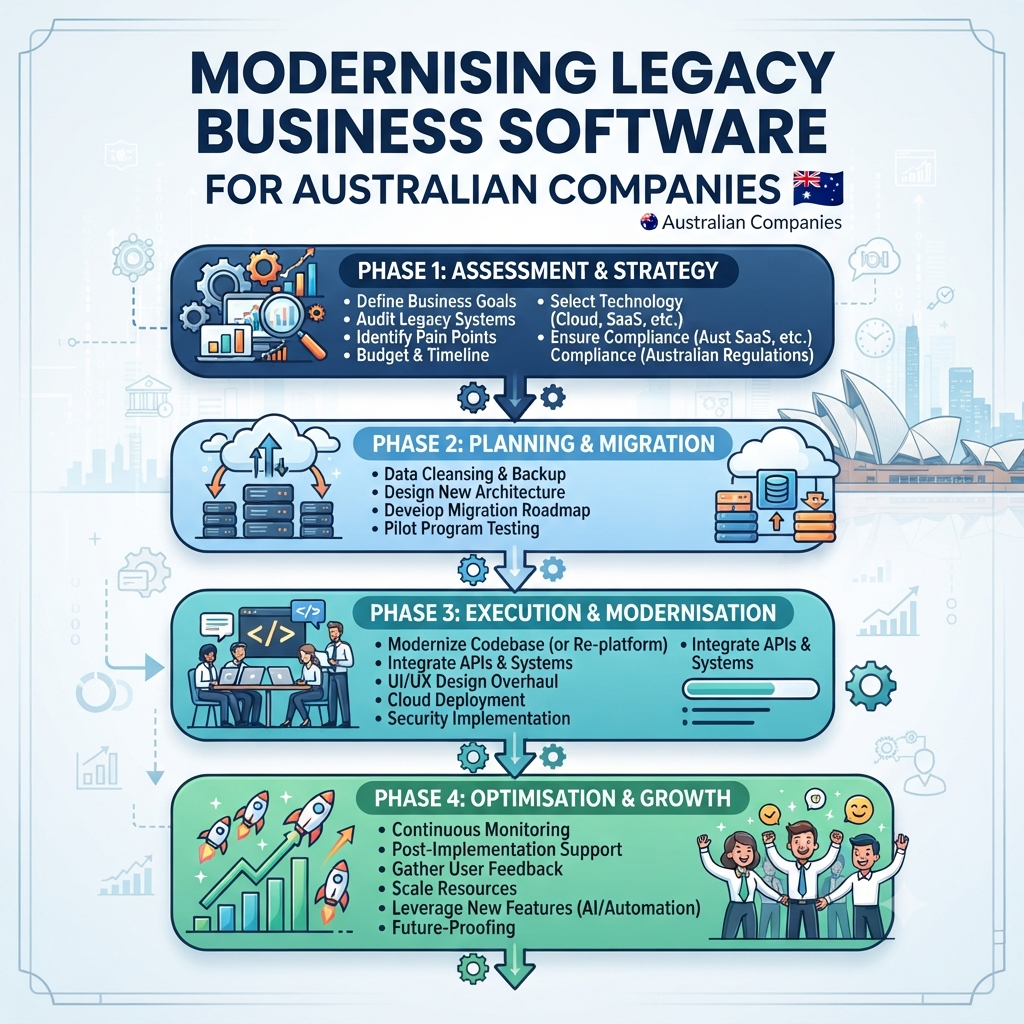
Modernising legacy software is not simply about replacing old applications. It involves identifying operational challenges, improving existing systems, and adopting technology that supports long-term business objectives.
1. Why Outdated Business Software Becomes a Problem
Legacy software often becomes a challenge when business operations expand. A system that worked efficiently for a small team may struggle to support multiple departments, larger customer databases, and increasing transaction volumes.
Some common problems include:
- Slow performance: Older applications may take longer to process information and complete routine operations.
- Limited integration: Legacy systems may not connect easily with modern CRM, ERP, accounting, or inventory platforms.
- Higher maintenance costs: Finding developers who can maintain older technologies can become increasingly difficult.
- Security concerns: Unsupported software may lack important security updates and modern protection mechanisms.
- Manual operations: Businesses may continue performing repetitive tasks that could otherwise be automated.
Identifying these problems helps businesses understand whether their existing software requires improvements, integration, or complete redevelopment.
2. Signs Your Business Needs Software Modernisation
Not every older application needs immediate replacement. However, certain warning signs indicate that existing technology may be restricting business performance.
Increasing operational delays: Employees spend too much time waiting for applications or completing tasks manually.
Poor system compatibility: Existing software cannot communicate effectively with newer business tools.
Difficulty scaling operations: The application struggles when the business adds new users, customers, products, or locations.
Frequent technical issues: Regular errors, downtime, and performance problems interrupt business activities.
Limited reporting capabilities: Management cannot access accurate, consolidated information for decision-making.
When these challenges begin affecting customer experience and employee productivity, investing in software modernisation becomes a practical business decision.
3. How Modern Software Development Improves Business Operations
Modern software solutions help businesses simplify complex processes and create more connected working environments.
Here are some important improvements businesses can achieve.
Business Process Automation
Automation reduces repetitive administrative work such as data entry, invoice processing, order management, and customer follow-ups. Employees can spend more time on customer service and important business activities.
Better System Integration
API development and integration allow different applications to exchange information. For example, connecting CRM, accounting, and inventory systems can reduce duplicate data entry and improve information accuracy.
Improved Data Management
Modern databases and centralised information systems help businesses organise, access, and analyse important business information more effectively.
Enhanced Security
Modern applications can incorporate access controls, encryption, security monitoring, and regular maintenance to help protect business information.
Scalable Infrastructure
Cloud-based architecture and scalable application design can help businesses accommodate increasing workloads without completely rebuilding their systems.
4. Choosing the Right Modernisation Approach
Every business has different technical requirements. Therefore, choosing the right approach depends on the condition of existing software, available resources, and long-term business objectives.
Application Rehosting: Moving an existing application to modern hosting infrastructure without significantly changing its code.
Application Refactoring: Improving the internal code structure to make software easier to maintain and update.
System Reengineering: Redesigning important application components to improve performance, functionality, and compatibility.
Complete Software Replacement: Developing a new application when the existing system is too outdated, insecure, or difficult to maintain.
A professional development team can assess the existing infrastructure and recommend the most suitable approach based on business priorities.
5. What to Look for in Software Development Services in Australia
Selecting a technology partner requires more than comparing development prices. Businesses should evaluate the provider's technical capabilities, development approach, communication, and ability to understand operational requirements.
When evaluating the best software development services in Australia, consider the following factors:
- Technical expertise: Check experience with relevant programming languages, frameworks, databases, and development technologies.
- Custom development capabilities: Ensure the team can build solutions around specific business workflows rather than offering only standard products.
- Integration experience: Look for expertise in connecting existing applications with modern business platforms.
- Security practices: Understand how the development team handles data protection, access management, and application security.
- Testing procedures: Check whether the provider performs functional, performance, compatibility, and security testing.
- Post-launch support: Confirm that maintenance, updates, and technical assistance are available after deployment.
A reliable development partner should understand both the technical requirements and the business outcomes expected from the project.
6. Why Custom Software Can Be a Better Long-Term Investment
Off-the-shelf applications are useful for businesses with standard requirements. However, companies with specialised workflows may find that ready-made software cannot address all their operational needs.
Custom software development provides greater flexibility by allowing businesses to build applications around their actual processes.
For example:
- A logistics company can develop a centralised platform for shipment tracking and delivery management.
- A manufacturing business can automate production monitoring and inventory management.
- A retail company can integrate sales, stock management, and customer information.
- A professional services firm can create a project management system with automated reporting and task allocation.
Custom solutions can also be expanded as business requirements change, making them suitable for companies planning long-term digital improvements.
7. How Mithila Softech Helps Businesses Build Better Software Solutions
Mithila Softech provides technology-focused services designed to help businesses improve their digital infrastructure and operational efficiency.
From custom software development and web application development services in Australia to API integration and software testing, the company focuses on building solutions around business requirements.
Its development approach can help businesses:
- Identify software limitations and technical challenges.
- Develop applications tailored to operational requirements.
- Integrate different business systems.
- Improve application functionality and performance.
- Build scalable digital solutions for changing business needs.
Whether a company needs to improve an existing application or develop a completely new software platform, selecting the right technical approach is essential for achieving sustainable results.
Businesses looking to improve their technology infrastructure can explore Mithila Softech to learn more about its software development capabilities.
Conclusion
Outdated software should not become a barrier to business growth. As Australian companies expand, their technology infrastructure must support changing workflows, increasing customer expectations, and growing operational demands.
Modernising legacy applications, integrating business systems, automating repetitive tasks, and improving software security can help organisations build more efficient operations.
The key is to identify existing technology challenges and choose solutions that deliver measurable business value. Working with an experienced software development partner can help businesses make informed technology decisions and prepare their operations for future growth.
Frequently Asked Questions
1. What is legacy software modernisation?
Legacy software modernisation is the process of improving outdated applications through code updates, system integration, infrastructure upgrades, or complete redevelopment to meet current business and technical requirements.
2. Why should Australian businesses invest in custom software development?
Custom software development helps Australian businesses automate specialised workflows, improve operational efficiency, integrate existing systems, and build applications that match their specific requirements.
3. How do I know if my business software needs an upgrade?
Frequent technical issues, slow performance, increasing maintenance costs, security limitations, and difficulties integrating with modern applications are common indicators that software modernisation may be necessary.
4. Is it better to modernise existing software or develop a new application?
The decision depends on the condition of the existing application, maintenance requirements, security risks, and business objectives. Modernisation may be more practical when the existing system has a reliable foundation, while complete redevelopment may be better when major limitations cannot be resolved efficiently.
5. How long does a software modernisation project take?
The timeline depends on application complexity, existing infrastructure, integration requirements, testing, and project scope. Smaller improvements may take a few weeks, while complex enterprise-level projects can require several months.
← Back to Blogs