Many businesses depend on software systems that were developed several years ago. While these systems may still perform basic functions, they can become difficult to maintain, expensive to upgrade, and incompatible with modern business applications.
As businesses grow, their technology requirements also change. They need faster systems, better security, improved integrations, and software that can handle increasing amounts of data and users.
For Australian businesses, continuing to depend on outdated software can create unnecessary operational challenges. Legacy software modernization offers a practical way to upgrade existing systems without completely rebuilding every business process from scratch.
What Is Legacy Software Modernization?
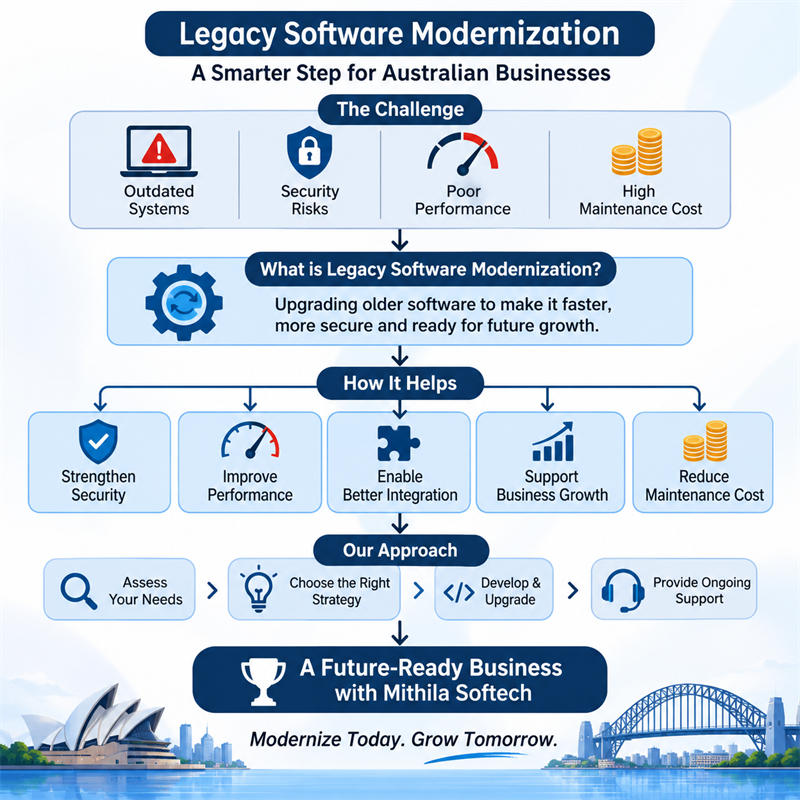
Legacy software modernization is the process of upgrading older software applications to make them more efficient, secure, and compatible with modern technologies.
Instead of replacing an entire system immediately, businesses can improve selected components, update the technology infrastructure, or gradually rebuild specific features.
Modernization may include:
- Updating outdated programming frameworks.
- Moving applications to cloud infrastructure.
- Improving database performance.
- Integrating modern APIs.
- Strengthening application security.
- Improving user interfaces and overall usability.
- Automating repetitive business processes.
The main objective is to make existing software more useful for current business requirements while preparing it for future growth.
Why Australian Businesses Should Consider Software Modernization
1. Reduce Software Maintenance Costs
Older applications often require specialized technical knowledge and additional maintenance. Finding developers who understand outdated technologies can also become difficult.
Modernizing the software can simplify maintenance, reduce technical complexity, and make future updates easier.
Businesses can gradually replace outdated components instead of investing in an expensive complete replacement.
2. Improve Data Security
Security requirements continue to evolve. Older software may depend on unsupported frameworks, outdated libraries, or security practices that no longer meet modern requirements.
Software modernization helps businesses introduce updated security measures, stronger authentication, better access controls, and regular system monitoring.
This is particularly important for businesses handling customer information, financial records, and confidential company data.
3. Connect Different Business Applications
Many businesses use separate applications for accounting, inventory, sales, customer management, and reporting.
When these systems cannot communicate properly, employees often need to enter the same information multiple times.
Modernization makes it easier to connect existing applications through APIs and integrations.
For example, a business can connect its inventory management system with its accounting software and online ordering platform to improve data accuracy and reduce manual work.
4. Improve Business Performance
Outdated applications may load slowly, struggle with large datasets, or experience performance issues when multiple employees access them.
Modern development technologies and optimized databases can improve application speed and reliability.
A better-performing system also helps employees complete daily tasks more efficiently and improves the experience for customers using digital platforms.
5. Prepare for Future Business Growth
Software that works for a small business may not support its requirements after expansion.
As customer numbers, transactions, and employees increase, businesses need systems that can handle additional workloads.
Modernized software can offer better scalability, allowing businesses to introduce new features, support more users, and expand their operations without constantly changing their technology infrastructure.
Common Approaches to Legacy Software Modernization
Not every business needs the same modernization strategy. The right approach depends on the existing system, budget, technical limitations, and future business objectives.
1. Rehosting
Rehosting involves moving an existing application to a different infrastructure, such as a cloud environment, without making major changes to its internal code.
It can help businesses improve infrastructure flexibility and reduce dependence on older physical servers.
2. Refactoring
Refactoring means improving the internal structure of existing software without changing its main functionality.
Developers reorganize the code, remove unnecessary complexity, and improve maintainability.
This approach is useful when an application works correctly but has become difficult to update.
3. Replatforming
Replatforming involves moving software to a modern technology platform while making selected improvements to its functionality and performance.
It allows businesses to benefit from updated infrastructure without completely rebuilding the application.
4. Rebuilding
Sometimes, an existing application has too many technical limitations to justify continued upgrades.
In such cases, rebuilding selected modules or developing a completely new application may be a better option.
Businesses can use this opportunity to introduce improved workflows, modern interfaces, automation, and advanced integrations.
Signs Your Business Needs Software Modernization
Business owners should evaluate their existing software if they experience the following problems:
- Employees regularly face application errors or downtime.
- Software updates are expensive and time-consuming.
- Existing applications cannot integrate with newer tools.
- The system struggles when business operations expand.
- Security updates and technical support are limited.
- Employees depend on manual work because software lacks automation.
- Customers experience slow or outdated digital interfaces.
Identifying these issues early can help businesses avoid larger technical problems in the future.
How to Choose the Right Software Development Partner in Australia
Selecting a development partner is an important decision because software modernization affects business operations, data, and long-term technology investments.
Businesses evaluating the best software development company in australia should consider more than pricing and project delivery timelines.
Here are some important factors to evaluate:
1. Technical Expertise: Check whether the development team understands modern programming technologies, databases, cloud platforms, and application integrations.
2. Business Understanding: A development partner should understand your operational challenges before recommending technical solutions.
3. Custom Development Capabilities: Every business has different requirements. Look for a team that can develop solutions according to your workflows rather than offering only standard software.
4. Security Practices: Discuss data protection, access management, application testing, and security updates before starting development.
5. Ongoing Support: Software requires regular maintenance, monitoring, and improvements. Choose a partner that can support the application beyond its initial launch.
How Mithila Softech Helps Businesses Build Better Software Solutions
Mithila Softech provides technology and digital solutions designed to help businesses improve their operations and digital capabilities.
Its development services can support businesses looking to build or improve their technology infrastructure through:
- Custom software development tailored to business requirements.
- Web application development for business operations.
- CRM and ERP solutions for managing business processes.
- API development and third-party application integrations.
- Database management and optimization.
- Application improvements and technology upgrades.
The focus is on understanding business requirements and developing practical digital solutions that support efficiency, performance, and future expansion.
Businesses planning a new software project or looking to improve an existing application can explore Mithila Softech's development services to identify a suitable approach.
Conclusion
Legacy software should not become a limitation to business growth. Outdated applications can increase maintenance costs, affect productivity, and make it difficult to introduce new business capabilities.
Software modernization helps businesses improve existing systems, strengthen security, simplify integrations, and prepare their technology infrastructure for future requirements.
With the right development strategy and technical partner, Australian businesses can transform older applications into reliable digital solutions that support long-term operational efficiency and business growth.
Frequently Asked Questions
1. What is legacy software modernization?
Legacy software modernization is the process of upgrading outdated applications, technologies, and infrastructure to improve performance, security, compatibility, and maintainability.
2. Why is software modernization important for businesses?
It helps businesses reduce maintenance challenges, improve security, automate operations, connect different applications, and support future expansion.
3. Is it better to modernize existing software or develop a new application?
It depends on the condition of the existing software. If the application has a reliable foundation, modernization may be more cost-effective. If it has major technical limitations, rebuilding may be a better option.
4. How long does a software modernization project take?
The timeline depends on application complexity, the number of modules, integration requirements, and testing needs. Smaller upgrades may take a few weeks, while large enterprise modernization projects can take several months.
5. Can software modernization help small businesses?
Yes. Small businesses can benefit from improved automation, better application performance, reduced manual work, and more efficient business processes. Modernization can also help them prepare for future growth without immediately investing in a completely new system.
← Back to Blogs