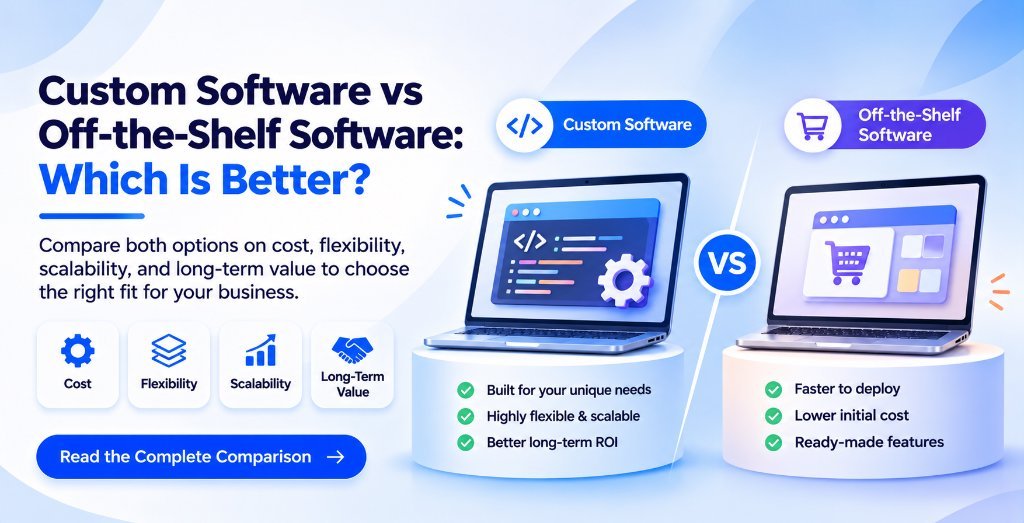
As businesses expand, their operational requirements become more complex. Managing customers, processing orders, tracking inventory, handling employee activities, and analyzing business performance often require reliable software solutions.
Many organizations initially depend on ready-made applications because they are easy to access and require minimal setup. However, as business operations grow, these applications may not provide all the features, integrations, or flexibility required.
This is where the decision between custom software and off-the-shelf software becomes important.
Both options offer different advantages depending on business size, budget, operational requirements, and future goals. Understanding these differences can help business owners make better technology investments.
What Is Custom Software Development?
Custom software development is the process of designing and building software specifically according to an organization's requirements.
Instead of adjusting business operations to match an existing application, businesses get software designed around their workflows, objectives, and operational challenges.
For example, a manufacturing company may require software that manages production schedules, raw materials, supplier information, inventory, and order processing through one integrated platform.
A custom solution can bring these functions together based on the company's actual requirements.
Common examples include:
- Custom CRM systems.
- Enterprise Resource Planning (ERP) software.
- Inventory management applications.
- Business automation platforms.
- Employee management systems.
- Custom e-commerce applications.
- Industry-specific management software.
The main advantage is flexibility. Businesses can select the features, integrations, and functionality they actually need.
What Is Off-the-Shelf Software?
Off-the-shelf software refers to ready-made applications developed for general business or individual use.
These products are designed to serve multiple customers with similar requirements. Businesses can purchase subscriptions, licenses, or usage plans and start using the software without developing an application from scratch.
Examples include:
- Microsoft 365 for productivity.
- QuickBooks for accounting.
- Salesforce for customer relationship management.
- Shopify for e-commerce.
- Trello for project management.
Off-the-shelf applications are useful when businesses need standard functionality without investing in a separate development project.
However, customization options may be limited depending on the product and subscription plan.
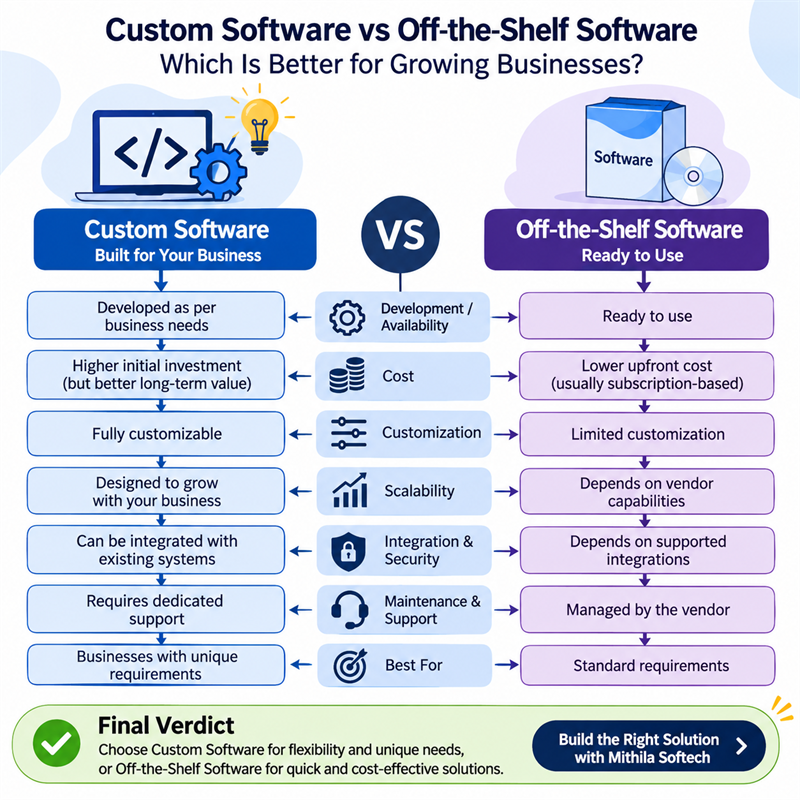
Custom Software vs Off-the-Shelf Software: Key Differences
Both software approaches can support business operations, but they differ in several important areas.
| Comparison Factor | Custom Software | Off-the-Shelf Software |
|---|---|---|
| Development | Built according to business requirements | Already developed |
| Initial Cost | Generally higher | Usually lower |
| Implementation | Requires development and testing | Often available immediately |
| Customization | High flexibility | Depends on available features |
| Scalability | Can be designed around future needs | Depends on vendor capabilities |
| Integration | Can be developed for specific systems | Depends on supported integrations |
| Maintenance | Requires planned technical support | Usually managed by the vendor |
| Ownership | Depends on the development agreement | Usually licensed or subscription-based |
| Security | Can be designed around specific security requirements | Depends on vendor security practices |
| Functionality | Designed for specific workflows | Designed for broader user requirements |
The right option depends on how closely the available software matches the organization's actual needs.
Advantages of Custom Software for Growing Businesses
Custom software can be a valuable investment for organizations with specialized workflows or long-term technology requirements.
1. Designed Around Business Requirements
Every business has different operational processes.
For example, a logistics company may need shipment tracking, fleet management, delivery scheduling, and automated customer notifications.
A standard application may not support all these processes in one place.
Custom development allows businesses to create features based on their specific workflows instead of depending entirely on predefined functionality.
2. Better Integration With Existing Systems
Growing businesses often use multiple applications for accounting, customer management, inventory, communication, and reporting.
Managing disconnected systems can create duplicate work and inconsistent information.
Custom software can be developed to integrate with existing applications through APIs and other supported communication methods.
This helps improve data exchange and operational efficiency.
3. Flexible Scalability
As a business grows, its software requirements may change.
An organization might need additional users, new modules, advanced reporting, automated workflows, or integration with external platforms.
Custom software can be extended according to changing requirements, provided the underlying architecture is designed to support future development.
4. Greater Control Over Features
Businesses do not always need every feature included in a ready-made application.
Custom software allows organizations to prioritize the functionality that supports their operations.
This can create a more focused user experience and reduce dependency on unnecessary features.
5. Long-Term Business Alignment
Custom software can be developed around an organization's long-term operational strategy.
Businesses can plan updates, introduce new functionality, and modify workflows as their requirements evolve.
However, this also means planning for ongoing maintenance, security updates, and technical support.
Advantages of Off-the-Shelf Software
Off-the-shelf applications remain a practical choice for many businesses, particularly when requirements are standard.
1. Faster Implementation
Ready-made software is already developed and tested for general use.
Businesses can usually create an account, configure basic settings, and begin using the application without waiting for a complete development cycle.
2. Lower Initial Investment
Most off-the-shelf products offer subscription-based pricing or affordable licensing options.
This makes them accessible to startups and small businesses that cannot immediately invest in custom development.
3. Regular Product Updates
Software vendors generally manage product improvements, bug fixes, security updates, and new functionality.
Businesses can benefit from these updates without managing the entire development process themselves.
4. Established User Support
Popular software products often provide documentation, tutorials, customer support, and user communities.
This makes it easier for employees to learn the application and resolve common issues.
5. Predictable Features and Pricing
Subscription plans generally provide clear information about available features, usage limits, and pricing.
This can help businesses estimate their initial software expenses more easily.
Custom Software vs Off-the-Shelf Software: Which Is More Cost-Effective?
Cost is one of the most important factors when selecting business software.
However, comparing only the initial purchase or development cost can lead to incorrect decisions.
Off-the-shelf software may have a lower starting cost, but subscription charges, additional user licenses, premium integrations, and usage-based fees can increase expenses over time.
Custom software generally requires a higher initial investment because it involves requirement analysis, design, development, testing, and deployment.
However, the total cost depends on application complexity, maintenance requirements, infrastructure, and future enhancements.
Businesses should evaluate the total cost of ownership (TCO), which includes:
- Initial development or licensing costs.
- Implementation and configuration expenses.
- Employee training.
- Integration costs.
- Maintenance and support.
- Subscription renewals.
- Future upgrades and additional features.
The most economical option is the one that provides the required functionality and value over the expected period of use.
When Should a Business Choose Custom Software?
Custom software is worth considering when existing applications cannot adequately support business operations.
It may be the right choice when:
- Business workflows are highly specialized.
- Multiple applications need to communicate with each other.
- Existing tools create operational limitations.
- The company requires industry-specific functionality.
- The business expects significant changes in its operational requirements.
- Greater control over application features and development is important.
For example, a manufacturing business managing complex production workflows may benefit from a custom platform connecting procurement, production, inventory, and reporting.
When Is Off-the-Shelf Software a Better Choice?
Ready-made software is often suitable when business requirements are common and well-supported by existing products.
Consider off-the-shelf software when:
- You need standard accounting or productivity tools.
- Your budget is limited.
- You need software immediately.
- Your team requires commonly used business applications.
- Existing features already match your workflows.
- You do not need extensive customization or specialized integrations.
A startup may find that a standard CRM or accounting application provides everything needed during its early stages.
There is no reason to invest in custom development if an existing product already solves the problem effectively.
Important Factors to Consider Before Selecting Business Software
Before choosing either option, businesses should evaluate several important factors.
1. Business Requirements: Identify the problems the software needs to solve and the features required to address them.
2. Budget: Consider both initial expenses and ongoing costs, including maintenance, subscriptions, and future upgrades.
3. Scalability: Understand how software requirements may change as the business expands.
4. Integration Requirements: Check whether the software can connect with existing business applications and databases.
5. Data Security: Evaluate authentication, access controls, backup procedures, encryption, and data management policies.
6. Technical Support: Determine who will handle maintenance, troubleshooting, updates, and technical issues.
7. Long-Term Flexibility: Consider whether the selected solution can support future operational changes without creating unnecessary limitations.
Can Businesses Combine Custom and Off-the-Shelf Software?
Yes. Businesses do not always have to choose only one approach.
A hybrid software strategy combines ready-made applications with custom-developed components.
For example, a company may use an existing accounting platform but develop a custom inventory management application that integrates with it.
Similarly, an organization may use a standard CRM while developing custom dashboards and reporting tools to meet its specific requirements.
This approach can reduce development expenses while providing flexibility where standard software falls short.
The important part is ensuring that integrations are reliable, secure, and maintainable.
How Mithila Softech Helps Businesses Choose the Right Software Solution
Selecting the right software approach requires understanding business processes, technical requirements, and long-term objectives.
Mithila Softech helps businesses explore software development solutions aligned with their operational needs.
From custom application development to business software integration, the focus should be on building practical solutions that address real challenges.
A structured development process can include:
- Understanding business requirements.
- Planning software architecture.
- Designing user-friendly interfaces.
- Developing application functionality.
- Integrating APIs and databases.
- Testing application performance.
- Supporting deployment and future improvements.
Whether a business needs a new application or wants to improve an existing system, selecting the right development approach is essential for long-term results.
Conclusion
Custom software and off-the-shelf software both play important roles in modern business operations.
Off-the-shelf applications offer faster implementation, lower initial expenses, and convenient access to standard features. Custom software provides greater flexibility, specialized functionality, and the ability to build around unique business processes.
The right decision depends on your organization's requirements, budget, existing technology, and future growth plans.
Businesses should not invest in complex software simply because it offers more features. Instead, they should select a solution that solves their actual operational problems and supports long-term objectives.
Looking for software that fits your business requirements? Connect with Mithila Softech to explore custom software development solutions designed around your business goals.
Frequently Asked Questions (FAQs)
1. What is the main difference between custom software and off-the-shelf software?
Custom software is developed according to specific business requirements, while off-the-shelf software is a ready-made product designed for multiple users. Custom software offers greater flexibility, whereas ready-made applications generally provide faster implementation.
2. Is custom software more expensive than off-the-shelf software?
Custom software usually requires a higher initial investment because it involves planning, development, and testing. Off-the-shelf software generally has lower upfront costs, although subscriptions and additional features can increase long-term expenses.
3. Which software is better for small businesses?
Off-the-shelf software is often suitable for small businesses with standard requirements and limited budgets. However, custom software may be beneficial when specialized workflows, integrations, or operational requirements cannot be handled effectively by existing applications.
4. Can custom software integrate with existing business applications?
Yes. Custom software can integrate with existing applications through APIs, database connections, and other supported integration methods. This helps businesses exchange information between different systems and streamline operations.
5. Is custom software suitable for growing businesses?
Yes. Custom software can be developed with future business requirements in mind, including additional features, users, integrations, and workflows. Its long-term effectiveness depends on proper architecture, maintenance, and continuous improvements.
← Back to Blogs