
Many businesses consider developing a mobile app because their competitors have one or because customers increasingly use smartphones for everyday activities.
But an app should not be developed simply because having an app sounds useful. The more important question is: What business problem will the app solve?
A well-planned mobile application can simplify customer interactions, automate repetitive processes, improve sales, centralize information, and create new ways for customers to engage with a business.
However, achieving these results requires more than attractive screens. The application needs to be planned around actual business requirements.
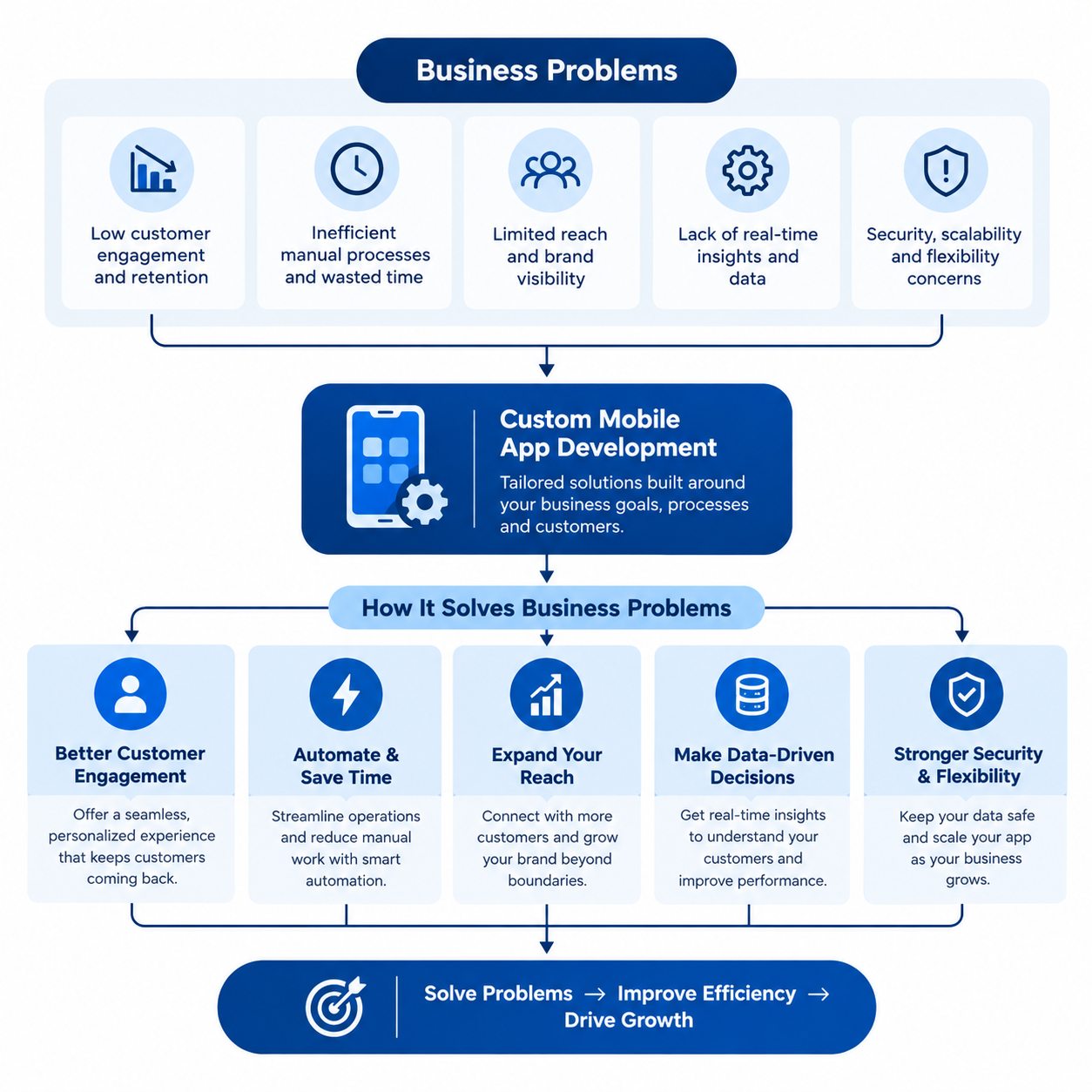
Problem 1: Customers Have Difficulty Accessing Your Services
If customers need to repeatedly visit your website, call your business, send emails, or search through different platforms to access your services, the experience can become inconvenient.
For example, a service business may require customers to:
- Check availability
- Submit enquiries
- Book appointments
- Make payments
- Track requests
- Contact support
through separate channels.
The Solution: Put Important Actions in One App
A custom mobile application can bring these activities together.
Depending on the business model, customers may be able to log in, view services, make bookings, receive notifications, make payments, and track their requests from one place. This creates a more organized customer journey while reducing unnecessary steps.
Problem 2: Your Business Relies Too Much on Manual Processes
Many businesses still manage customer requests manually through spreadsheets, emails, phone calls, or messaging applications. This can become difficult as the number of customers increases.
For example, an employee may need to manually:
- Receive a customer request
- Record the information
- Forward it to another team member
- Update the customer
- Change the status
- Follow up later
Repeating this process hundreds of times can consume significant employee time.
The Solution: Business Process Automation
Custom mobile app development services can connect customer-facing features with an administrative system.
A customer could submit a request through the app, while the internal team receives the information through a unified admin dashboard. The system can then manage statuses, notifications, assignments, and records based on the business requirements.
This does not mean every process should be automated. The goal is to automate repetitive tasks where technology can reduce unnecessary manual work.
Problem 3: Customers Are Not Returning Regularly
A customer may purchase from a business once and then forget about it. A website can provide information, but a mobile application can create a more direct channel for ongoing engagement.
The Solution: Useful App-Based Engagement
Businesses can use features such as:
- Push notifications
- Personalized offers
- Order updates
- Appointment reminders
- Loyalty programs
- Saved preferences
- New product notifications
The important point is relevance. Sending too many notifications can frustrate users. Notifications should provide information or offers that are genuinely useful to the customer.
Problem 4: Your Sales Process Has Too Many Steps
A customer may discover a product or service through search or social media but abandon the process because purchasing requires too many steps.
For eCommerce businesses, this could mean moving from an advertisement to a website, creating an account, finding a product, adding it to a cart, and completing a complicated checkout.
The Solution: Simplify the Customer Journey
A custom application paired with intuitive UI/UX design can be designed around the specific sales process. For example:
- Retail / E-commerce: Product Discovery → Product Details → Add to Cart → Payment → Order Tracking
- Service-based Business: Service Selection → Select Date → Enter Details → Payment → Confirmation
The fewer unnecessary steps customers have to complete, the easier it becomes to move from interest toward action.
Problem 5: Your Business Data Is Spread Across Different Systems
Businesses often use separate tools for customers, orders, payments, inventory, communication, and reporting. When these systems do not communicate properly, employees may need to enter the same information multiple times.
This can create unnecessary work and increase the possibility of inconsistent data.
The Solution: Integrate the App With Your Existing Systems
Custom app development can include integrations with existing business systems where appropriate. Depending on the requirements, an application may connect with:
- CRM systems
- Payment gateways
- Inventory systems
- Accounting and ERP software
- Booking platforms
- Customer databases
- Custom APIs
- Analytics platforms
This allows the application to become part of the existing business infrastructure rather than functioning as an isolated product.
Problem 6: A Standard App Template Does Not Fit Your Business
Pre-built applications can be useful for businesses with simple requirements. However, businesses with unique workflows may find that templates do not provide the functionality they actually need. Adding numerous workarounds can eventually make the system complicated.
The Solution: Custom Mobile Application Development
With custom mobile app development, the application can be planned around the company's processes.
- For example, a logistics company may need delivery tracking, driver accounts, route information, customer notifications, and proof-of-delivery functionality.
- A healthcare-related platform may require appointment scheduling, user accounts, notifications, and secure information management.
- A retail business may need product catalogues, shopping carts, payments, order tracking, and loyalty features.
The application should therefore be designed according to the business model rather than forcing the business into a fixed template.
How to Decide What Your App Actually Needs
One of the biggest mistakes businesses make is trying to include every possible feature in the first version. Instead, start with the core problem.
- Step 1: Identify the Business Problem: Ask what is currently slowing down customers, employees, sales, or operations.
- Step 2: Define the User: Determine who will use the application. This could include customers, employees, delivery staff, sales teams, vendors, or administrators.
- Step 3: Identify the Core Action: Determine what users should be able to accomplish inside the application (e.g., Book → Pay → Track or Browse → Purchase → Track Order).
- Step 4: Build the MVP: A Minimum Viable Product should contain the essential features needed to solve the primary problem. Additional features can be introduced after receiving real user feedback.
- Step 5: Connect the Required Systems: Determine whether the application needs payment, CRM, inventory, accounting, notification, or other integrations.
- Step 6: Test With Real Users: Testing should cover usability, performance, security, navigation, forms, payments, notifications, and different device sizes.
Why Businesses Need More Than Just App Design
An attractive interface is important, but design alone cannot solve an operational problem. A successful application requires coordination between:
Business Requirements → UX/UI Design → Development → Integration → Testing → Launch → Continuous Improvement
This is why businesses looking for an app development company should evaluate more than screenshots or visual designs. The development partner should understand the business process behind the application.
Conclusion
A mobile application can become a valuable business tool when it is built around a genuine business requirement.
Whether the goal is to simplify bookings, automate manual processes, improve customer engagement, increase sales, or connect different business systems, the application should have a clearly defined purpose.
Custom mobile app development services allow businesses to build functionality around their specific customers and workflows instead of relying entirely on generic solutions.
The right starting point is not, “What features should our app have?” It is: “What problem are we trying to solve?” Once that problem is clearly defined, the technology, features, integrations, and development roadmap become much easier to plan.
Mithila Softech partners with businesses worldwide to design, develop, and deploy scalable iOS, Android, and cross-platform mobile applications that solve real operational challenges and drive customer growth.
FAQs
1. When does a business need a custom mobile app?
A business may benefit from a custom app when it has recurring customer interactions, manual processes that can be automated, complex workflows, or a need for a dedicated mobile experience.
2. How much does custom mobile app development cost?
The cost depends on factors such as the number of platforms, features, integrations, design requirements, backend infrastructure, security requirements, and development complexity. A clear requirements document is usually needed before providing an accurate estimate.
3. Should I build an Android app, iOS app, or both?
The decision depends on your target customers, geographic market, usage data, budget, and business objectives. A development team can help determine which platform strategy fits your audience.
4. Can a mobile app integrate with existing business software?
Yes. Depending on the available APIs and technical architecture, an app can integrate with CRM, payment, inventory, accounting, booking, analytics, and other systems.
5. Should I build all features in the first version?
Not necessarily. Starting with an MVP containing the most important features can allow a business to test the concept with real users before investing in additional functionality.