
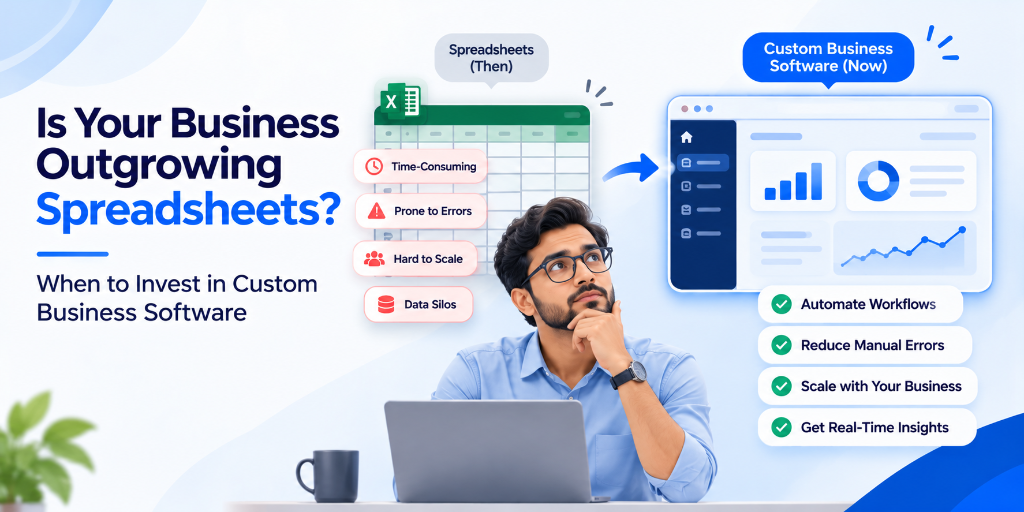
Spreadsheets are often the first choice for businesses managing customer information, sales records, inventory, employee details, and daily operations. They are affordable, familiar, and easy to use. However, as a company grows, managing everything through spreadsheets can become increasingly difficult.
Multiple files, repeated data entries, outdated records, and manual reporting can slow down business activities. Employees may spend more time updating information than completing important tasks. These problems can eventually affect customer service, team productivity, and business decisions.
This is when businesses should consider moving towards a more structured software solution.
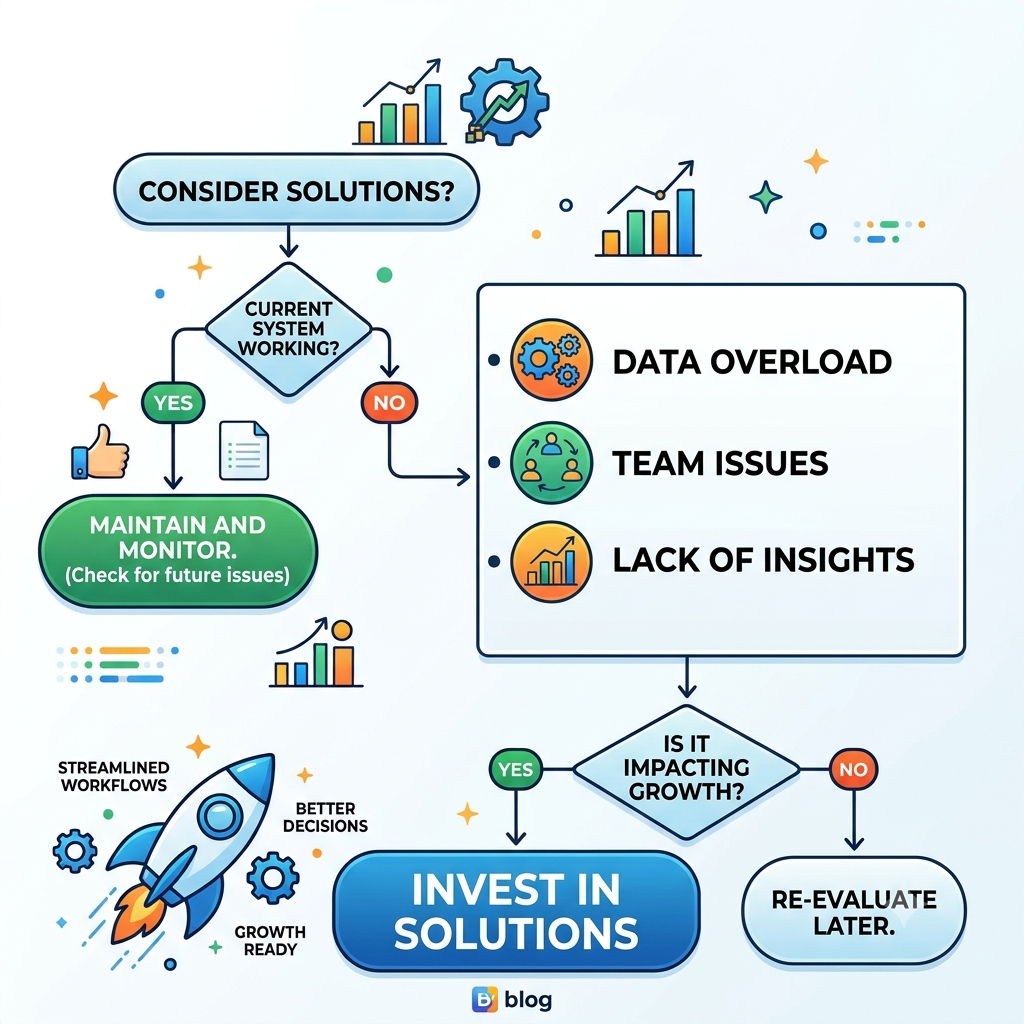
1. Your Team Is Managing Too Many Separate Files
When different departments maintain separate spreadsheets, finding accurate information becomes challenging.
For example, the sales team may maintain customer details in one file, the accounts department may track payments separately, and the operations team may manage orders in another document.
This creates several problems:
- Duplicate customer records.
- Inconsistent business information.
- Delayed communication between departments.
- Difficulty tracking ongoing activities.
A centralized software platform can bring important business information together, allowing authorized employees to access updated records from one system.
2. Manual Tasks Are Consuming Valuable Working Hours
Many businesses still perform repetitive activities manually, including preparing reports, updating inventory, sending reminders, calculating expenses, and assigning tasks.
Although these activities may appear simple, they consume considerable time when repeated every day.
Business automation can reduce unnecessary manual work by handling routine activities through predefined workflows. For example, software can automatically update inventory after a sale, generate invoices, notify employees about pending tasks, and send customer follow-up reminders.
This allows employees to focus on customer relationships, planning, and business development instead of repetitive administrative work.
3. Customer Information Is Becoming Difficult to Manage
Customer information is one of the most valuable business resources. However, when contact details, enquiry history, sales conversations, and follow-up schedules are stored in different places, sales opportunities can easily be missed.
A centralized customer management platform helps businesses:
- Maintain organized customer profiles.
- Track enquiries and sales opportunities.
- Schedule follow-up activities.
- Monitor sales team performance.
- Maintain communication history.
Working with a reliable CRM software development company can help businesses create a customer management system that matches their sales process, reporting requirements, and customer engagement strategy.
4. Different Departments Are Working Without Proper Coordination
As businesses expand, departments become increasingly dependent on one another. Sales needs inventory information, accounts needs transaction records, and management needs performance reports.
When these departments use disconnected tools, employees often need to request information manually.
An integrated enterprise platform can connect different business functions through a shared system. This improves information flow and reduces unnecessary communication gaps.
An experienced ERP software development company can build an enterprise resource planning solution that connects departments such as finance, inventory, human resources, procurement, sales, and operations.
5. Your Existing Software Cannot Support Changing Requirements
Ready-made software can be useful during the early stages of business operations. However, not every company follows the same workflow.
Some businesses need industry-specific approval processes, customized reporting, unique pricing structures, specialized inventory management, or integrations with existing applications.
When standard software cannot support these requirements, businesses may need a more flexible solution.
Professional custom software development services help companies build applications around their actual business processes instead of forcing employees to adjust their work according to software limitations.
6. Business Reports Are Taking Too Long to Prepare
Business owners need accurate information to make decisions. However, when reports require collecting data from multiple files and manually combining information, decision-making becomes slower.
Custom reporting dashboards can bring important business metrics into one place.
Depending on business requirements, dashboards can display:
- Monthly revenue and expenses.
- Sales performance and conversion rates.
- Inventory availability.
- Employee productivity.
- Customer acquisition trends.
- Pending orders and payments.
With organized reporting, management can identify operational problems earlier and make more informed decisions.
7. Data Security and Access Control Are Becoming Important
As companies grow, more employees require access to business information. However, not every employee should have permission to view or modify every record.
A properly developed business application can include role-based access, secure authentication, activity tracking, and controlled permissions.
Businesses should also consider regular backups, data recovery procedures, software updates, and security testing.
These measures help protect important business information while maintaining accountability across departments.
How to Choose the Right Software Development Approach
Not every business needs a complete enterprise platform immediately. The right solution depends on existing challenges, operational complexity, and future plans.
| Business Requirement | Suitable Software Solution |
|---|---|
| Managing customer enquiries and sales follow-ups | CRM Software |
| Connecting finance, inventory, HR, and operations | ERP Software |
| Automating specialized business workflows | Custom Business Software |
| Connecting different applications | API Integration |
| Monitoring performance and business data | Reporting Dashboard |
Before starting development, businesses should identify their most time-consuming processes and prioritize the problems that affect productivity or revenue.
Why Businesses Should Plan Software Development Before Scaling
Waiting until operational problems become serious can make software implementation more complicated.
A planned approach allows businesses to introduce new systems gradually, train employees, migrate existing data, and test important workflows before full deployment.
The development process should generally include:
- Requirement Analysis: Understand existing business operations and identify improvement opportunities.
- Solution Planning: Define essential features, user roles, integrations, and technical requirements.
- UI/UX Design: Create an easy-to-use interface for employees and management.
- Software Development: Build and integrate the required functionality.
- Testing: Check performance, security, usability, and data accuracy.
- Deployment and Support: Launch the application and provide ongoing maintenance.
The objective should not simply be to purchase or develop another software application. It should be to create a system that solves genuine operational problems and supports future business requirements.
Conclusion
Spreadsheets and basic business applications are useful tools, but they may not remain sufficient as business operations become more complex. Managing disconnected information, repetitive tasks, customer records, and departmental activities can eventually reduce productivity and create unnecessary operational challenges.
Investing in the right business software can help companies organize their processes, improve communication, automate routine work, and make better decisions.
Mithila Softech helps businesses explore technology solutions aligned with their operational requirements, from business applications and workflow automation to integrated ERP and CRM platforms.
If your existing tools are limiting your business growth, it may be the right time to evaluate a more structured software solution.
Visit: https://www.mithilasoftech.com/ to explore software development solutions for your business.
Frequently Asked Questions (FAQs)
1. When should a business move from spreadsheets to custom software?
A business should consider custom software when spreadsheets become difficult to manage, data duplication increases, reporting takes too long, or employees spend excessive time on repetitive tasks.
2. What are the benefits of custom business software?
Custom business software helps automate workflows, centralize information, improve operational efficiency, simplify reporting, and support business-specific requirements.
3. How does ERP software help growing businesses?
ERP software connects departments such as finance, inventory, HR, sales, and operations. It improves information sharing, reduces manual work, and provides better visibility into business activities.
4. Is CRM software useful for small and medium-sized businesses?
Yes. CRM software helps small and medium-sized businesses organize customer information, track enquiries, manage sales pipelines, schedule follow-ups, and improve customer relationships.
5. How much time does it take to develop custom business software?
Development time depends on the application's complexity, features, integrations, and testing requirements. A basic business application may take a few weeks, while a complex ERP or CRM platform may require several months.
← Back to Blogs