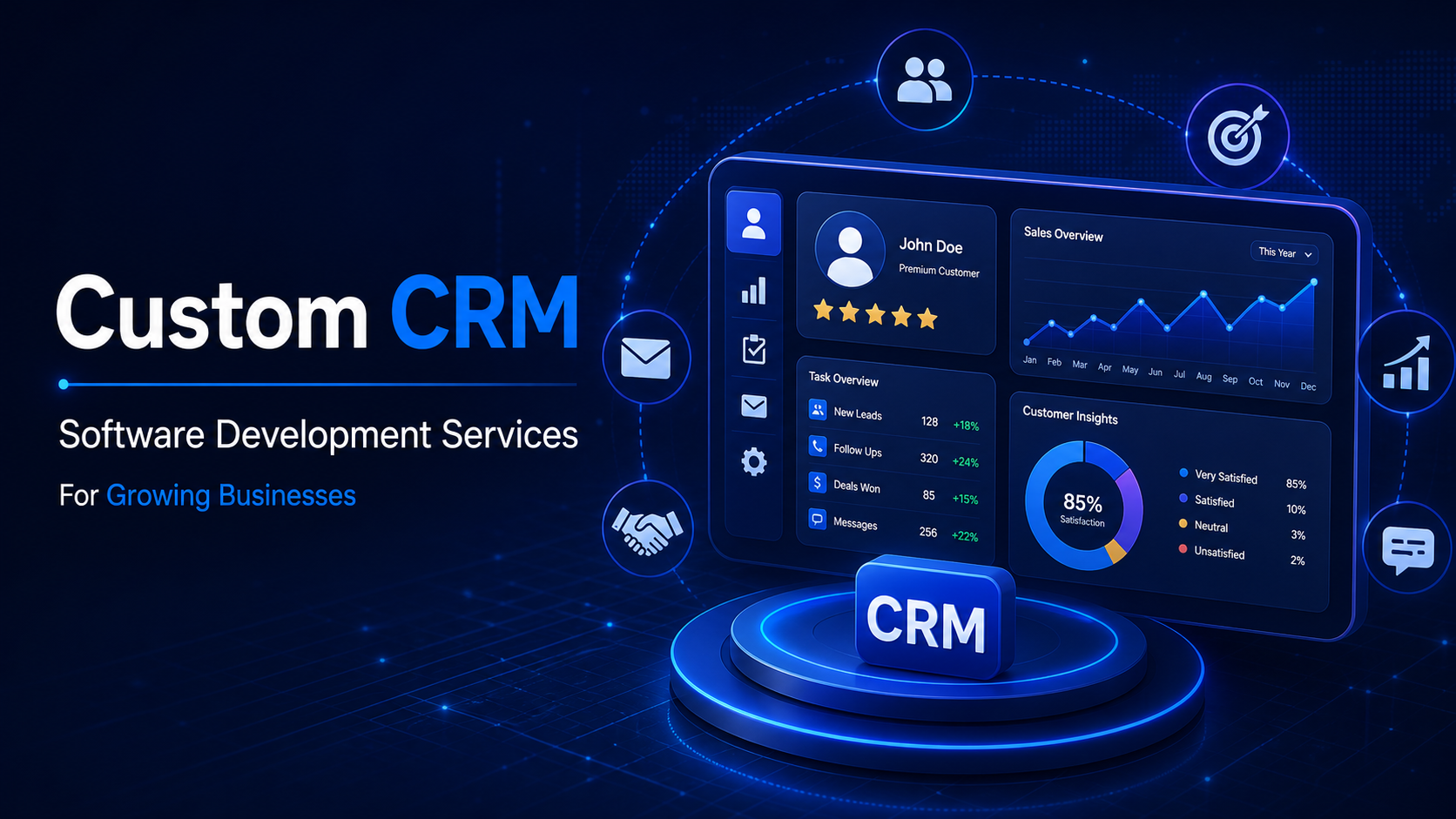
Customer relationships are the foundation of every successful business, but managing leads, sales, follow-ups, and customer interactions manually can become overwhelming as your business grows. Custom CRM software development provides a centralized solution that helps businesses organize customer data, automate repetitive tasks, improve communication, and increase sales efficiency.
In today's competitive market, customer experience is one of the biggest factors influencing business success. Whether you run a startup, retail business, healthcare organization, educational institution, or enterprise, maintaining strong customer relationships is essential for long-term growth.
Many businesses still rely on spreadsheets, emails, and disconnected tools to manage customer information. This often leads to missed follow-ups, lost sales opportunities, duplicate data, and poor communication between teams.
Custom CRM software development solves these challenges by providing a centralized platform where businesses can manage leads, customers, sales activities, support tickets, and marketing campaigns from one place. Unlike off-the-shelf CRM systems, custom CRM software is designed around your unique workflows, allowing you to automate repetitive tasks, improve team collaboration, and gain valuable customer insights.
What Is CRM Software?
Customer Relationship Management (CRM) software helps businesses organize and manage customer interactions throughout the entire customer lifecycle. It stores customer information, tracks communication history, manages sales pipelines, automates follow-ups, and generates performance reports.
- Capture leads
- Track sales opportunities
- Manage customer communication
- Schedule follow-ups
- Automate workflows
- Generate reports
- Improve customer service
With all customer data stored in one secure platform, businesses can provide faster and more personalized service.
Why Businesses Choose Custom CRM Development
Every company has unique sales processes and customer management requirements. Generic CRM software often includes unnecessary features while lacking the flexibility needed for specific business operations.
- Business-specific workflows: The software is designed around your organization's existing sales and customer management processes.
- Sales automation: Automatically assign leads, schedule follow-ups, send reminders, and manage customer communication.
- Better customer experience: Employees have complete access to customer history, enabling faster and more personalized support.
- Improved collaboration: Sales, marketing, and customer support teams work from the same centralized database.
- Scalability: As your business grows, additional modules and integrations can be added without changing the entire system.
Essential Features of Custom CRM Software
- Lead management: Lead capture, lead assignment, lead tracking, and lead scoring.
- Contact management: Customer profiles, communication history, documents, and notes.
- Sales pipeline: Opportunity tracking, deal stages, sales forecasting, and revenue reports.
- Marketing automation: Email campaigns, customer segmentation, campaign tracking, and marketing reports.
- Customer support: Ticket management, complaint tracking, service history, and resolution monitoring.
- Reporting dashboard: Sales performance, customer insights, revenue analytics, and employee productivity reports.
Industries That Benefit from CRM Software
Custom CRM software is suitable for real estate, healthcare, education, manufacturing, retail, e-commerce, finance, insurance, logistics, and professional services. Each industry can customize CRM modules according to its operational needs.
Benefits of Custom CRM Software
- Improved customer retention
- Higher sales conversions
- Better lead management
- Faster response times
- Increased employee productivity
- Automated routine tasks
- Enhanced reporting
- Better decision-making
- Stronger customer relationships
CRM vs Spreadsheet Management
| CRM Software | Spreadsheet |
|---|---|
| Centralized customer data | Scattered information |
| Automated follow-ups | Manual tracking |
| Real-time reporting | Limited analysis |
| Team collaboration | Difficult sharing |
| Scalable | Hard to manage |
| Better security | Higher risk of errors |
Technologies Used for CRM Development
Modern CRM software is developed using technologies such as React, Angular, Node.js, Laravel, Python, Java, .NET, MySQL, PostgreSQL, MongoDB, AWS, and Microsoft Azure. Cloud-based CRM solutions provide secure remote access and seamless scalability.
How to Choose a CRM Software Development Company
- Industry experience
- Portfolio
- Customization capabilities
- Security standards
- Integration expertise
- Support services
- Pricing transparency
- Client reviews
A trusted software company ensures smooth implementation and long-term support.
Conclusion
A custom CRM solution empowers businesses to build stronger customer relationships, streamline sales processes, and improve operational efficiency. By automating repetitive tasks and providing a centralized platform for managing customer interactions, CRM software enables organizations to increase productivity, improve customer satisfaction, and drive sustainable business growth.
Partnering with an experienced CRM software development company ensures your solution is tailored to your unique business requirements, scalable for future growth, and equipped with the latest technologies. Whether you are a startup or an established enterprise, investing in custom CRM software is a smart step toward creating lasting customer relationships and achieving long-term success. Many businesses also connect CRM with custom ERP software, mobile app development, and web application development for a complete digital workflow.
Frequently Asked Questions
1. What is custom CRM software?
Custom CRM software is a customer relationship management system built specifically for a business's workflows, allowing organizations to manage leads, customers, sales, and support more efficiently.
2. How is custom CRM different from ready-made CRM software?
Custom CRM software is fully tailored to your business needs, while ready-made CRM platforms offer standard features with limited customization.
3. Which businesses should invest in CRM software?
Businesses of all sizes across industries such as healthcare, real estate, education, retail, manufacturing, logistics, and finance can benefit from CRM software.
4. Can CRM software integrate with existing business applications?
Yes. Custom CRM solutions can integrate with ERP systems, accounting software, payment gateways, email platforms, marketing tools, and other third-party applications.
5. Why choose Mithila Softech for CRM software development?
Mithila Softech develops secure, scalable, and customized CRM solutions designed to improve customer management, automate business processes, and support long-term business growth with ongoing technical support.